

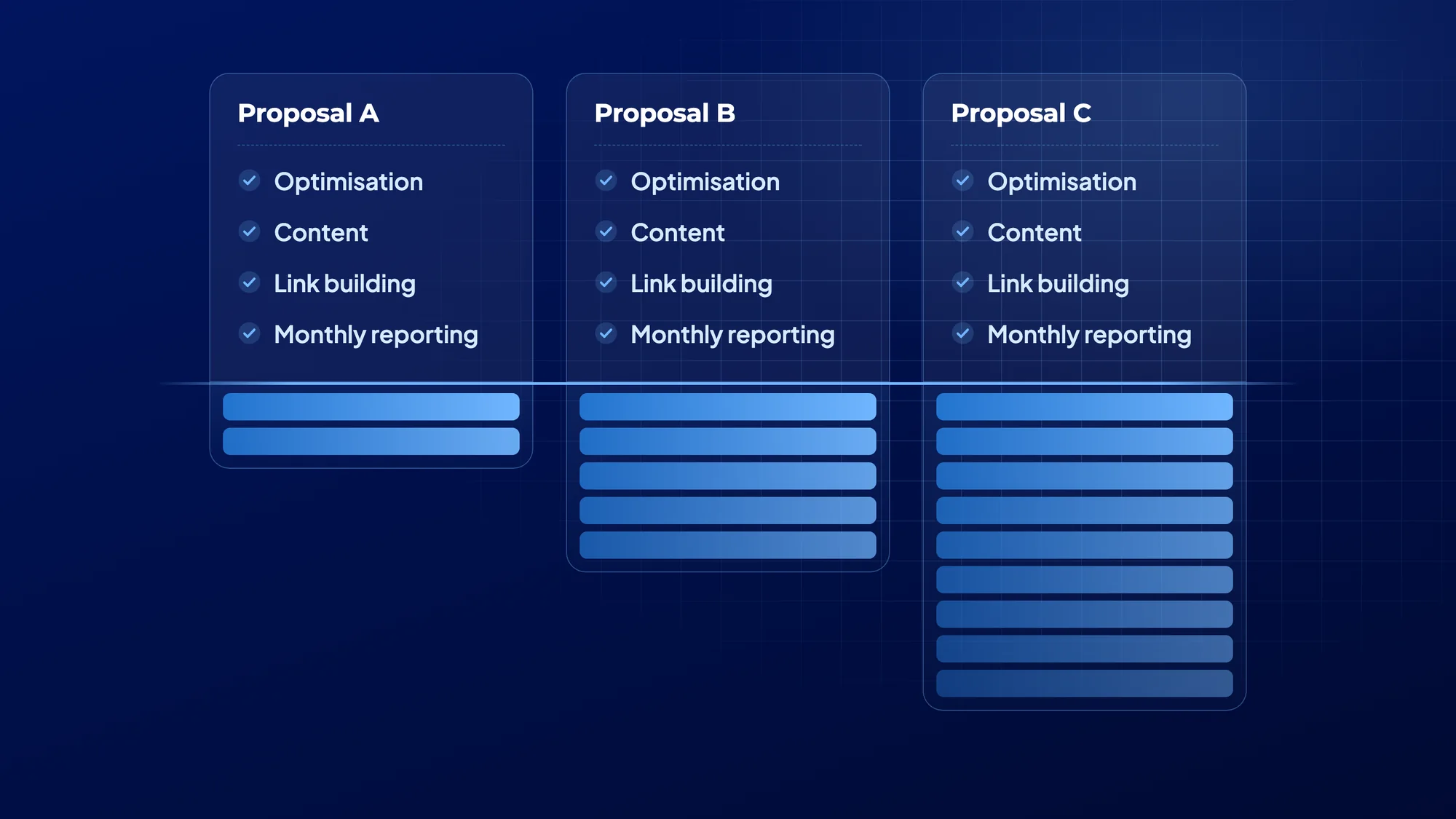
Ask three providers what dental SEO cost looks like. Typically you get three quotes that differ by a factor of five, all described in near-identical language. Optimisation, content, link building, monthly reporting. The words are the same. The work is not remotely comparable.
Therefore price is a poor first question. The useful one is what they deliver, at what depth, and what the provider will put in writing.
What follows describes what a search programme should contain, so you can judge a quote on substance rather than on the number at the bottom.
What does dental SEO cost in Canada?
Instead of quoting figures that would date badly and probably miss your market, it is more useful to describe what the bands actually contain. Providers cluster into roughly three tiers, and the differences between them are structural.
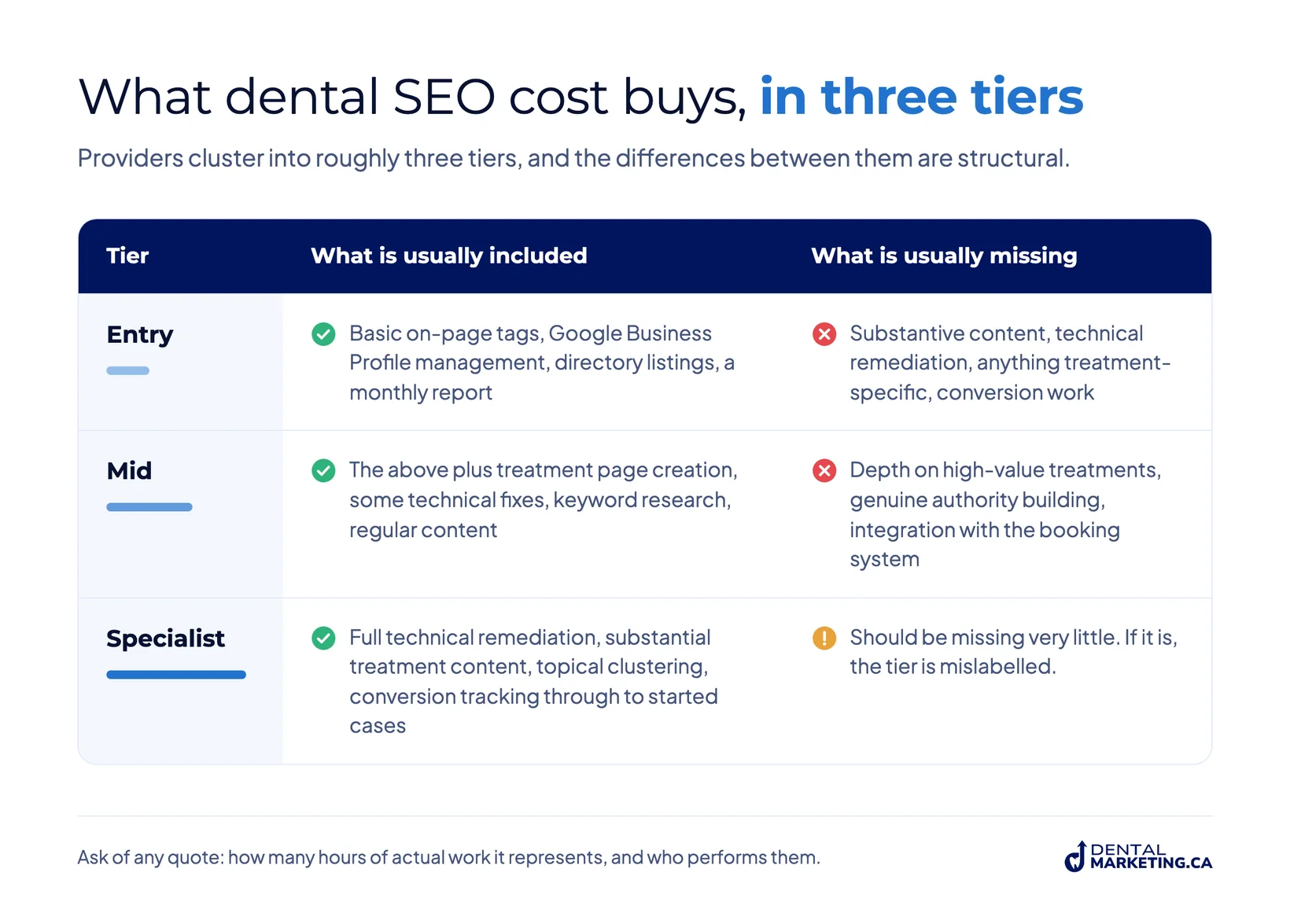
| Tier | What is usually included | What is usually missing |
|---|---|---|
| Entry | Basic on-page tags, Google Business Profile management, directory listings, a monthly report | Substantive content, technical remediation, anything treatment-specific, conversion work |
| Mid | The above plus treatment page creation, some technical fixes, keyword research, regular content | Depth on high-value treatments, genuine authority building, integration with the booking system |
| Specialist | Full technical remediation, substantial treatment content, topical clustering, conversion tracking through to started cases | Should be missing very little. If it is, the tier is mislabelled |
The single most useful question to ask about any quote is not what it costs but how many hours of actual work it represents and who performs them. A low monthly fee spread across a large client roster buys a small number of hours from a junior, whatever the proposal says.
Why dental SEO quotes differ so much
These numbers look irrational because most people shop for search work as though it were one thing, like buying the same box from two shops. So if one company says three thousand a month and another says three hundred, the obvious conclusion is that the first is gouging you. However, that is almost never what is happening. Instead, they are selling genuinely different work and calling it by the same name.
Four questions actually separate the quotes. Is anyone building authority to the site, or is that line item just directory submissions? Who writes the content, a person or a generator? Is it written for your practice, your equipment, your team and your city, or is it one treatment page dropped onto twenty other clinic sites with the town name swapped? Finally, has anybody checked it against your provincial advertising rules, given that the licence at risk is yours and not the agency’s?
Who actually writes the content
At Dental Marketing Canada, people with real clinical grounding write the content. Our writers range from medical and dental students through to people who have worked chairside. Every page is written for the individual practice rather than assembled from a template. Then a reviewer checks everything against provincial rules before it publishes. Certainly that is the expensive part. It is also the part that works, and on a health topic Google is explicit about caring who wrote it.
Below roughly a thousand dollars a month, we would not expect the work to move anything. Not because cheap providers are crooks. Rather, at that price the hours per client cannot cover a technical fix, a substantial treatment page and a compliance review in the same month. So the provider does only what scales. You get a report full of completed tasks and a ranking position that does not move. In that situation we would rather a practice fixed its website conversion problems first, then came back to search later.
Why is cheap dental SEO usually a bad deal?
However, this is not because cheap providers are dishonest. Rather, the arithmetic forces certain choices. A provider charging a low monthly fee must serve many clients to survive. Consequently there are few hours per client. So the work that scales gets done, and the work that does not gets skipped.
What scales: directory submissions, meta tag updates, templated blog posts, automated reporting. What does not scale: understanding a specific practice’s treatment mix, writing something genuinely substantive about full-arch implants, diagnosing why a site is not converting.
The scalable work is also the work with the least effect, which is the trap. So the practice receives activity and sees a report full of completed tasks. Yet nothing moves, because the skipped tasks were the ones that mattered.
There is a second cost that rarely appears in the comparison. Cheap content produced at volume is precisely the pattern search engines have spent recent years learning to discount, and on a Canadian dental site there is a further risk: content written to American conventions can breach your provincial advertising rules, and the liability for that sits with the licensee, not the provider.
What should a dental SEO cost include at each level?
So here is a checklist to hold any proposal against, roughly in order of impact.
- Technical audit and remediation. Indexation, crawlability, speed, structured data. If something suppresses your pages, nothing else matters until you fix it.
- Treatment page architecture. A page per treatment you actually want, written to the depth the topic requires rather than to a word count.
- Internal linking. Consistently the most neglected item and one of the highest yield. Google finds unlinked pages slowly and values them poorly.
- Local and Google Business Profile. Separate ranking system, faster to move, disproportionately valuable for treatment searches with local intent.
- Content on a real schedule. Fewer, deeper pieces beat frequent thin ones.
- Conversion tracking through to started cases. Without this, nobody can tell whether any of it worked.
- Compliance review before anything publishes. Canadian-specific and almost never included.
Items one, three and six are the ones most commonly absent from mid-tier proposals, and they are three of the four highest-impact items on the list.
Should you pay monthly or per project?
Generally both have a legitimate place, and the right answer depends on the state of the site.
Project pricing suits remediation. A technical audit and fix, or building a set of treatment pages, has a definable end. Paying monthly for work that finishes is how practices end up on indefinite retainers for maintenance.
Monthly suits the ongoing part. Content, monitoring, iteration and reporting genuinely are continuous, and search results move whether or not you are paying attention.
The structure to be wary of is a monthly fee with no defined deliverable, which converts into paying for availability rather than work.
One structure to avoid entirely in Canada: fees tied to the amount of business generated. Revenue share, payment per new patient, or performance bonuses linked to production. The RCDSO advisory instructs Ontario dentists not to engage in advertising promotion resulting in payments to a third party related to the business obtained, which reaches those models directly. A flat fee for work performed does not.
What should you ask before agreeing a dental SEO cost?
Finally, six questions, and the answers matter more than the price.
- Show me a Canadian dental client and what changed. Not a logo wall. Before and after, on specific terms, with dates.
- How many hours a month, and who does them? Named roles, not “our team”.
- What will you have completed by month two, four and six? In writing, before signing.
- How will you report started cases, not leads? If they cannot connect to the practice management system, they cannot report outcomes.
- Who reviews content against my provincial advertising rules? If the answer is nobody, the answer is you.
- What happens to the work if I leave? You should own the pages, the content and the accounts.
The question we wish practices asked
It is not about price at all. It is this. Show me the URL of everything you published for me in the last six months. Not a report, not a list of tasks, but the actual addresses of the actual pages. A provider doing the work can answer that in about a minute. Meanwhile a provider who cannot answer it has told you everything you needed to know, and asking costs you nothing.
For example, we audited a two clinic group in Ontario last year that had paid a monthly retainer to the same SEO company for six years. Under fifteen hundred a month, so not a bargain-basement arrangement. Six years had bought treatment pages of roughly a hundred and ninety words each. A competitor in the same town ran a thousand words or more on the identical treatments, so about five times the substance for patients searching the same terms.
What six years of retainers had actually bought
There was more. No structured data.
An analytics tag that had stopped reporting. Redirects pointing at the wrong treatments. And around forty near-duplicate location pages spread across the two websites, which is not merely wasted effort. In fact it sits close to the pattern Google’s own spam policies describe as doorway abuse, “having multiple domain names or pages targeted at specific regions or cities that funnel users to one page”. Consequently that can hold back a whole domain rather than only the offending pages.
The part that stayed with us was simpler. After six years she could not attribute a single enquiry to any of it, and the company only ever made contact when she chased them.
As for promises that cannot be delivered, the common one is a guaranteed position on a named keyword by a named date. Nobody controls the ranking system, and nobody controls what a competitor does next quarter. Therefore that promise is either a coincidence waiting to happen, or it is met by ranking you for a phrase nobody searches. The other is a revenue figure quoted before anyone has established a baseline. If a provider tells you what you will earn before installing tracking, they have guessed, and you will be the one who finds out.
Is dental SEO worth the cost?
The question is almost never whether the dental SEO cost is a large number in isolation. It is what that fee has to produce before it has paid for itself, and for most practices that figure is smaller than they expect.
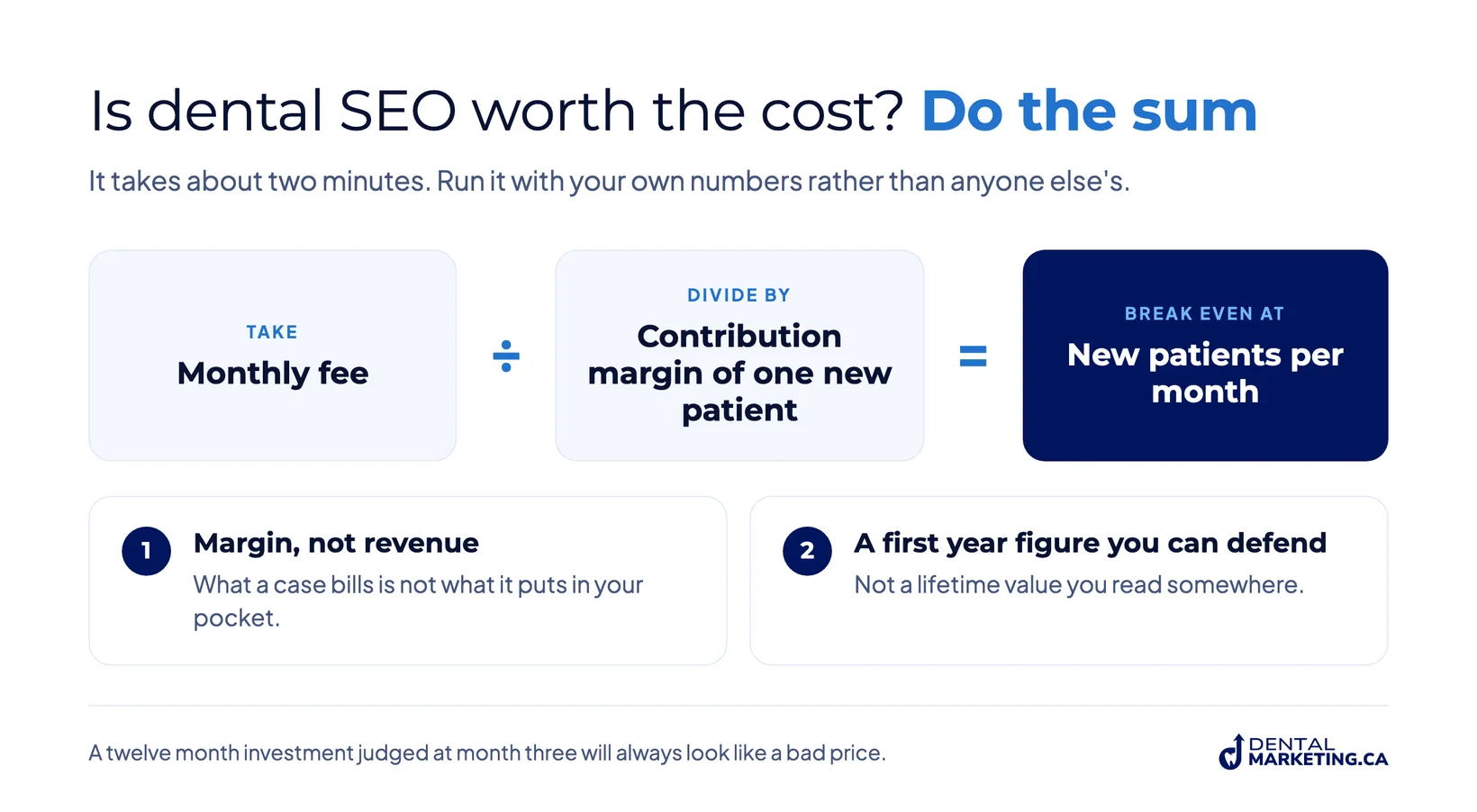
Usually the calculation takes about two minutes. Still, you should run it with your own numbers rather than anyone else’s:
Monthly fee, divided by the contribution margin of one new patient, equals the number of new patients per month at which you break even.
Two things matter about doing it this way. Use margin, not revenue, because a case that bills four thousand dollars does not put four thousand in your pocket. Also use a first year figure you can defend rather than a lifetime value you read somewhere. Typically the lifetime value numbers circulating in dental marketing have no methodology behind them. Indeed, people quote them precisely because they make the maths look good.
Run it and the shape becomes obvious quickly. At a dental SEO cost of fifteen hundred a month, a practice whose new patients carry a few hundred dollars of first year margin needs a handful of them monthly to be square. Meanwhile a practice aiming at implants, full arch or orthodontics is in a different position. There a single accepted case can carry several thousand dollars of margin. So one patient can cover a month’s fee, sometimes a quarter’s. Hence the pricing on high value treatment. Equally, the same fee is genuinely harder to justify for a practice doing hygiene recall alone.
Why the dental SEO cost arithmetic improves over time
Meanwhile three things make the comparison against paid advertising different, in a way that monthly invoices disguise.
- The asset persists. A treatment page that reaches a good position in month eight is still producing enquiries in month twenty without an incremental payment for each click. Advertising stops the day the card stops. This is the entire difference between renting attention and owning the position.
- It offsets ad spend rather than adding to it. Practices rarely count this, and it is often the largest single financial effect. As organic visibility grows on the terms you were bidding on, you can cut the paid budget on those same terms without losing volume. The programme is partly self-funding out of a line you were already paying.
- Your cost per patient falls while advertising’s does not. The auction broadly sets paid cost per acquisition, and it tends to drift upward as more practices bid. The cost per patient of an organic page falls every month it keeps working, because the cost was already spent.
However, the honest counterweight is that all three benefits arrive late. None of them help in month two. That is exactly why the cancellation problem described in how long dental SEO takes to work is so common. The economics are good and the sequencing is uncomfortable. Both are true.
What this looks like after a few years
We will be careful here, because the temptation in an article like this is to quote a return figure. Any number we gave you would come from someone else’s practice, with a different treatment mix, in a different city.
Still, the pattern is worth describing. Practices that stay with search work for years do not stay out of loyalty. Rather, at some point the channel quietly became the main way new patients found them, and stopping became unthinkable in a way that pausing an ad campaign never is. Typically it starts as the line they are least sure about and ends as the one they would cut last.
However, the other half of that observation is the part agencies leave out. It does not go that way for everyone. When it does not, the cause is usually one of two things. Either the practice could never measure it, so a channel that was working could not prove itself and got cut. Or the traffic arrived at a website that could not convert it, which is a separate problem covered in why a dental website gets traffic but no bookings. Neither is a reason the economics fail. Instead, both are reasons to fix the measurement and the site first.
How do you judge whether the dental SEO cost was worth it?
Certainly not by rankings, and not by traffic. By whether the dental SEO cost, over the period the work takes, is less than the margin of the cases it produced.
So the tracking has to exist before the work starts, which is the single most common omission. A practice that installs measurement in month nine has no baseline to compare against and will spend the rest of the engagement arguing about attribution. So agree what you will count, and how, before anything publishes.
The two inputs the calculation depends on are what a patient is genuinely worth to your practice and a realistic view of how long the work takes to produce anything. A twelve month investment judged at month three will always look like a bad price. Similarly, one that nobody measured will look like whatever the person describing it wants.
What a proposal should contain, and what it should cost, is something we will tell a practice plainly before it becomes an engagement, which is the approach behind how we run search work.
This article describes advertising and privacy rules as they applied on the review date shown. Regulations change and vary by province. This is general information, not legal advice. Confirm anything you intend to rely on with your own regulatory college.


 Speak to a dental marketing specialist