

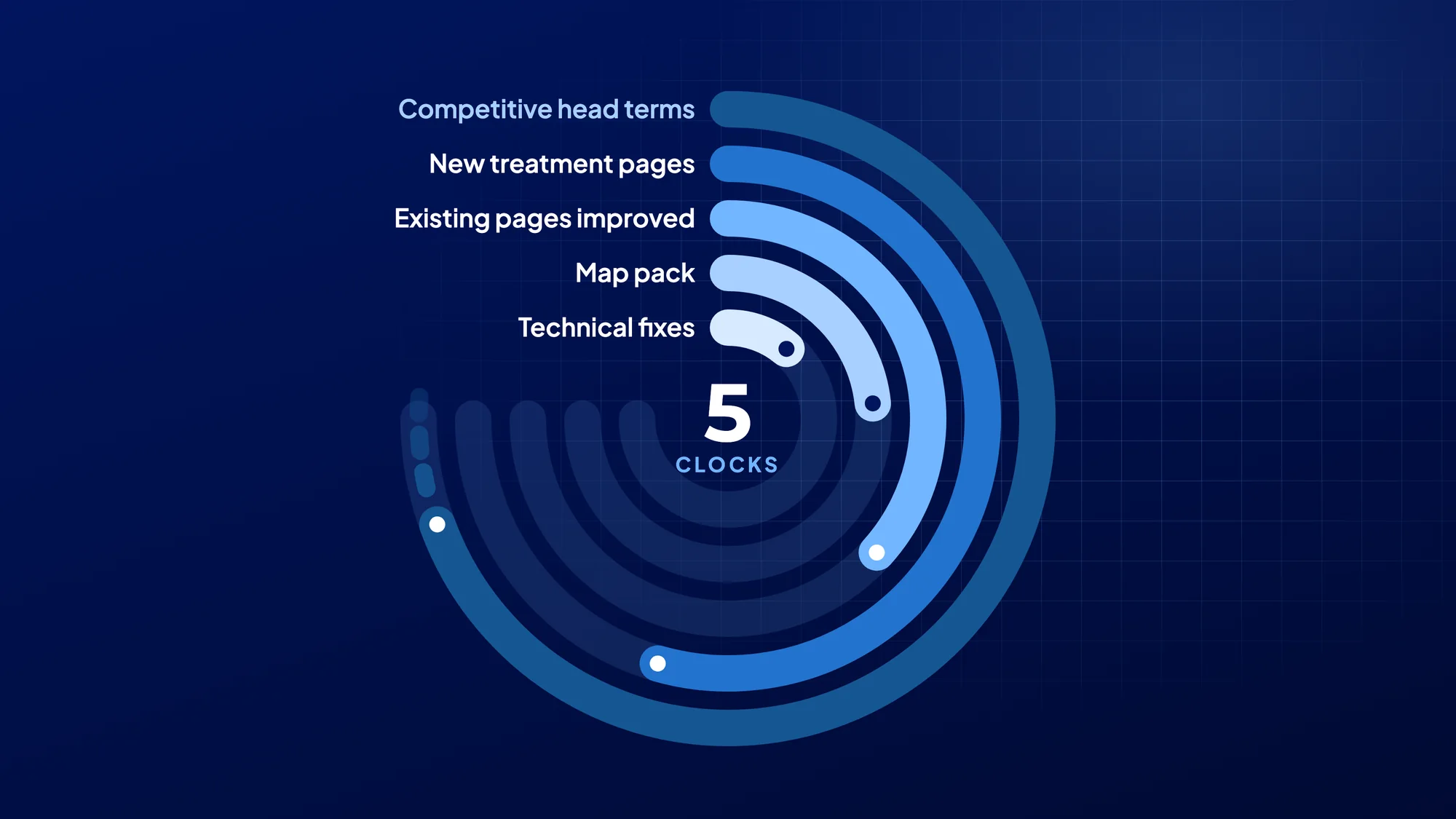
How long does dental SEO take? Every practice asks this before signing anything. Almost every answer is either “three to six months” or “it depends”. The first is a number chosen because it sounds reassuring. The second is true but useless. Dental SEO has no single timeline, because it is not a single activity.
Instead, it is four or five separate mechanisms running at once. Still, each one moves on its own clock. Knowing which is which is the difference between judging a campaign fairly and cancelling a working one.
So the mechanisms below all run at the same time in any dental SEO programme. They do not finish together.
How long does dental SEO take to work?
Typically the parts move at genuinely different speeds. Roughly, and as orientation rather than a promise:
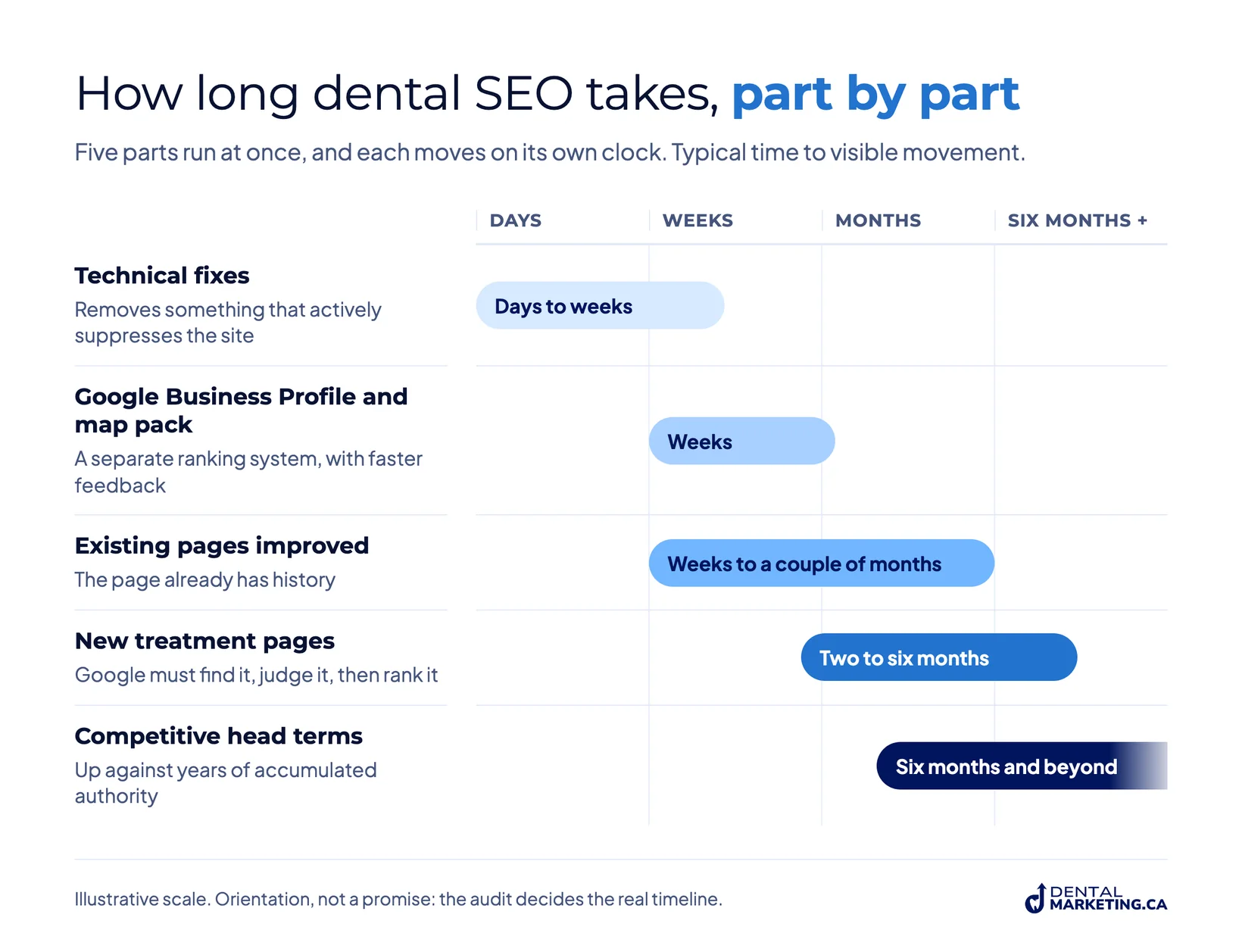
| What is being worked on | Typical time to visible movement | Why |
|---|---|---|
| Technical fixes | Days to weeks | Removes something that actively suppresses the site. Nothing has to be earned |
| Google Business Profile and map pack | Weeks | A separate ranking system, with fewer inputs and faster feedback |
| Existing pages improved | Weeks to a couple of months | The page already has history. You are moving it, not creating it |
| New treatment pages | Two to six months | Google must find it, judge it, then rank it against incumbents |
| Competitive head terms | Six months and beyond | You are up against sites with years of accumulated authority |
So a single number misleads for a simple reason. A campaign doing all five at once will show movement in week three, and still not have touched its most valuable target by month four. Indeed, both facts are true at the same time.
What moves first, and what takes longest?
The fastest wins are almost always removals rather than additions. A page accidentally set to noindex. Or a sitemap missing half the site. Perhaps a page nothing links to internally. Because fixing those earns nothing new, the effect can appear quickly.
By contrast, the slowest work is competing for terms where established sites already rank. That is not unusual, and it is not a sign of failure. Authority simply accrues, and the incumbents started earlier.
Between those two extremes sits most of the actual work. Generally you build the pages that answer what patients search for, then give them enough internal support to be found.
Why the dental SEO timeline differs between practices
Notably, two engagements can look identical on paper and behave nothing alike. The variable is almost never how hard anyone works. It is what the domain already has.
For example, take a practice opening its first clinic. No website, no reviews, no mentions anywhere. Initially it sits at the slow end of every range above, and no budget buys past it. Google has nothing to go on. Every signal has to be built from nothing, and that is the one part of this work nobody can accelerate.
The opposite case is the one most people misprice. A practice has been open fifteen years. Its site has years of crawl history. It picked up links without ever asking. It has real reviews and a name people search for. But the treatment pages run two paragraphs each, and nobody has touched them in a decade.
Obviously everyone looks at that site and assumes it is the hard one. Usually it is the fast one. To be precise about why, it is not the age of the domain. Google has said plainly that domain age on its own does nothing. Rather, the links, the crawl history and the local prominence already sit there with nothing worth ranking attached. Give them pages that genuinely answer something and the site can move in weeks instead of quarters. After all, nobody is being asked to trust a stranger.
So when a practice asks us for a timeline before we have looked at the domain, the honest answer is that we do not have one yet. In practice the audit is not a formality before the work starts. It is the thing that decides the timeline.
How long does dental SEO take to show a first real signal?
Weeks, and long before revenue. This is the part most practices never hear. If you wait for phone calls as your first evidence, you will wait months for something that arrives in weeks in a different form.
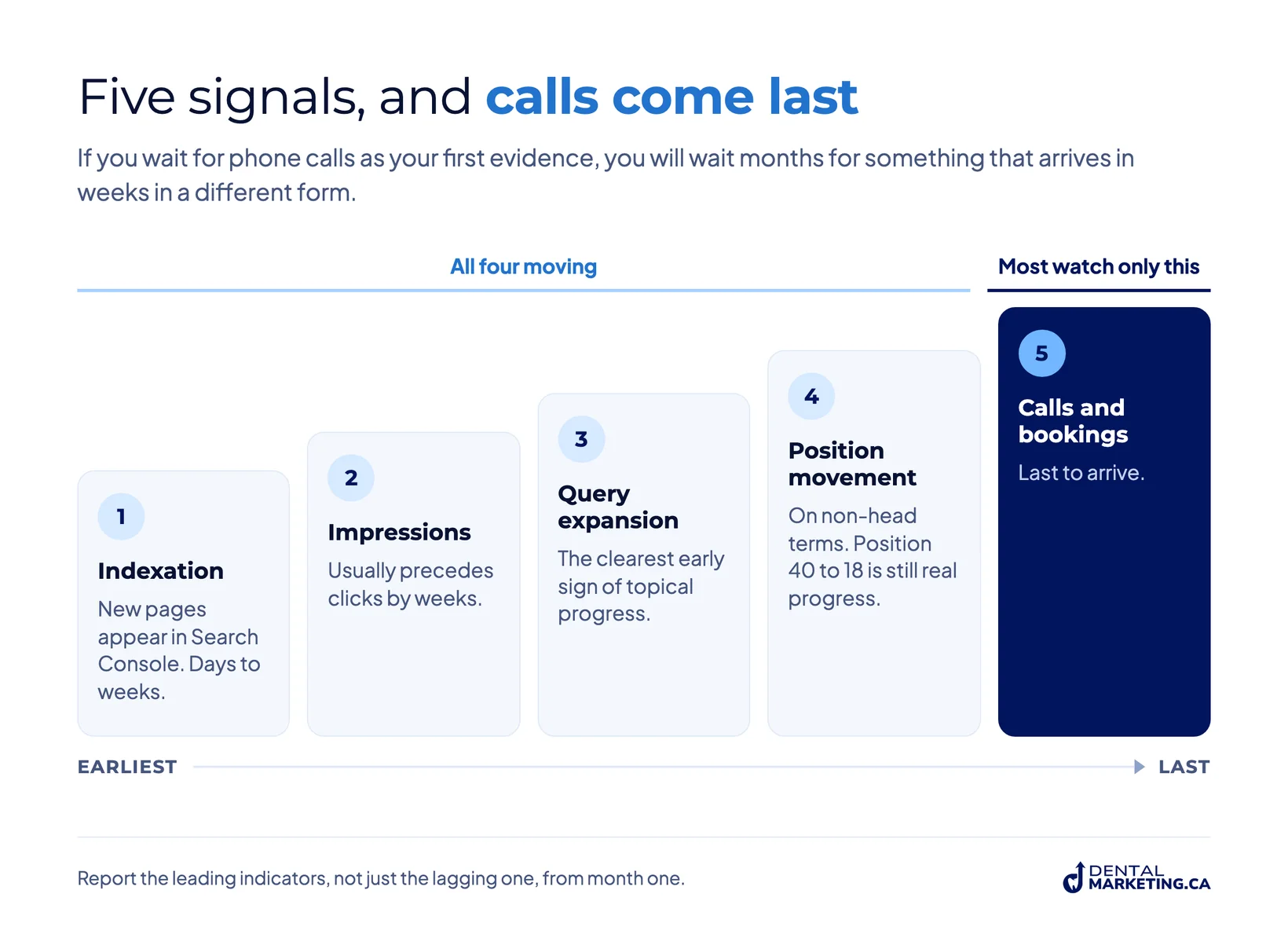
- Indexation. New pages appear in Search Console at all. Days to weeks. If this is not happening, nothing downstream will.
- Impressions. The site shows up for queries it was invisible for. Often the first genuine evidence, and it usually precedes clicks by weeks.
- Query expansion. The number of distinct searches returning the site grows. This is the clearest early sign of topical progress, and almost nobody reports it.
- Position movement on non-head terms. Moving from position 40 to 18 produces almost no traffic. Still, it is real progress.
- Calls and bookings. Last, and the only one most practices watch.
A practice watching only the fifth signal will conclude that nothing is happening for months, while the first four are all moving.
Why do practices cancel just before it works?
Because the cost is immediate and monthly, while the return is delayed and compounding. That shape is psychologically brutal. Five months of invoices, set against a signal nobody explained how to read, produces a rational-feeling decision to stop. Frequently that happens at the exact point where the curve was about to turn.
However, three things prevent it. All three are the provider’s job, not the practice’s:
- Report the leading indicators, not just the lagging one. Impressions and query counts, from month one.
- State the timeline honestly at the start, including which parts will be slow, so month four is not a surprise.
- Sequence the work so something moves early. Technical fixes and the map pack first. Not because they are the biggest prize, but because a practice needs evidence before it needs revenue.
How long does dental SEO take in a smaller Canadian market?
Often less time than in a large city, and that is one of the genuine structural advantages of working here.
Canada has roughly eighteen thousand dental practices with employees, 17,857 as of 2025 on Statistics Canada figures. In many markets, only a handful of practices compete seriously for a given treatment term. Fewer still publish anything substantial. Less competition for a position generally means less time to earn it.
However, a major metro behaves much more like an American market, with correspondingly longer timelines. A practice in a mid-sized Canadian city and one in downtown Toronto should not expect the same clock.
How to test your own market in five minutes
First, an honest word on the evidence. No controlled study measures how much faster results arrive in a small Canadian market than a large one. Anyone quoting a figure for that has invented it. What exists instead is a mechanism, and it is solid enough that you can test your own market this afternoon.
Second, ranking is comparative, not absolute. There is no standard you clear and no score you pass. Instead you displace a specific page, written by a specific competitor, sitting in a specific position. So the useful question was never how big your city is. It is how good the page in position three actually is.
That is why population is the wrong proxy. Some mid-sized markets are harder than they look, because one practice in town has taken this seriously for years. Meanwhile plenty of large suburban markets have nothing but two hundred word treatment pages on page one. In that situation a good page does not need to be extraordinary. It only needs to be the first substantial one.
The four questions to ask about page one
So run this yourself. Search your highest value treatment plus your city. Open the top three results that are not ads and not directories. For each one, ask four questions. Does it explain the cost, or what affects the price? Will it tell you who is a candidate and who is not? Can you find out what actually happens at the appointment? Finally, how long is it?
If all three are short and dodge every real question, your timeline sits at the fast end. The opportunity is also larger than your competitors realise. But if even one is thorough, useful and clearly maintained, plan for a longer run and a harder fight.
Ultimately that five minute exercise tells you more about your own timeline than any estimate an agency gives you before signing, including ours.
What makes dental SEO take longer than it should?
Overall, five causes, in rough order of frequency.
Publishing without internal linking. Google finds unlinked pages slowly and values them poorly. This is the most common self-inflicted delay, and the easiest to fix.
Content that cannot be published as written. Pages built to American conventions often carry claims that Canadian advertising rules restrict. Rewriting them afterwards costs weeks that should have been spent ranking.
Thin pages competing with substantial ones. A 400 word treatment page will not displace a thorough one, however well optimised. Therefore the fix is depth, not more pages.
Changing direction every quarter. Authority compounds only if the target stays still. A practice that redirects strategy every few months restarts the clock each time.
Ignoring conversion while you wait. Rankings that arrive at a site which cannot convert produce traffic and no patients, and the campaign gets the blame. Dental website traffic without bookings is a separate problem, and it surfaces at exactly the moment search starts working.
What to agree before you start
- Which specific terms and pages you are targeting, written down
- What gets reported monthly, including leading indicators
- What the provider expects to move by month two, month four and month six
- What happens if none of it moves, and when that conversation triggers
Certainly a provider unwilling to put a timeline in writing is telling you something. So is one who promises a specific ranking by a specific date, since nobody can guarantee either.
What the work costs, what different price points actually buy, and how to judge whether it pays for itself are covered in what dental SEO costs in Canada.
Setting honest expectations at the start, including the slow parts, is how we scope search work for a practice.
This article describes advertising and privacy rules as they applied on the review date shown. Regulations change and vary by province. This is general information, not legal advice. Confirm anything you intend to rely on with your own regulatory college.

 Speak to a dental marketing specialist