

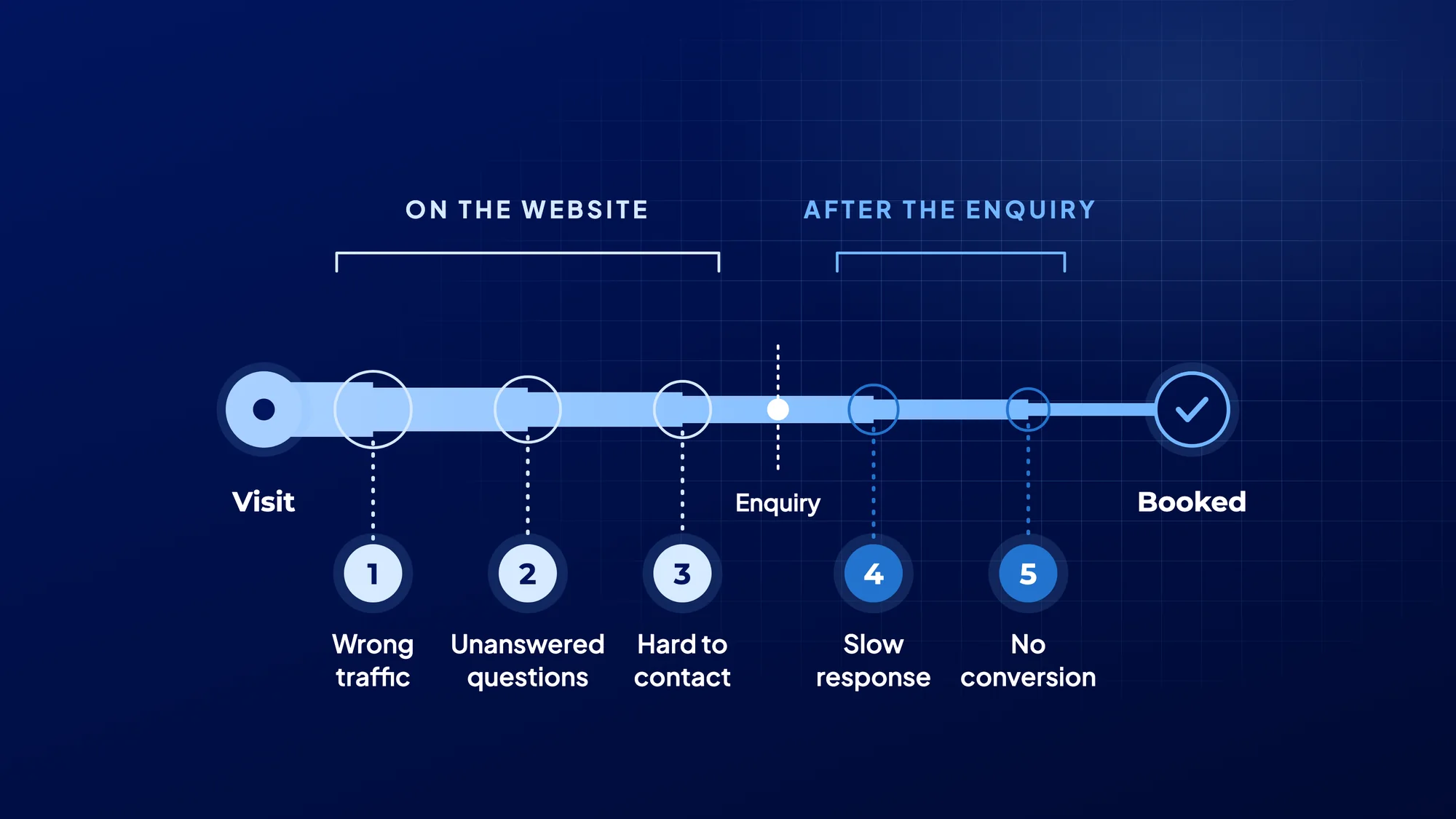
A practice arrives at this problem already frustrated. The dental website is getting visitors, the analytics prove it, and the phone is not ringing any more than it was. The instinctive conclusion is that the site needs rebuilding, and a redesign is the most expensive possible way to test that theory.
Instead it is worth being methodical, because in a meaningful share of cases the site is not the problem at all. Something after it is.
Only some of these are fixed by website work, which is exactly why diagnosing first saves money.
Why does a dental website get traffic but no bookings?
Generally there are only five places the failure can be, and you can diagnose them in about an hour.
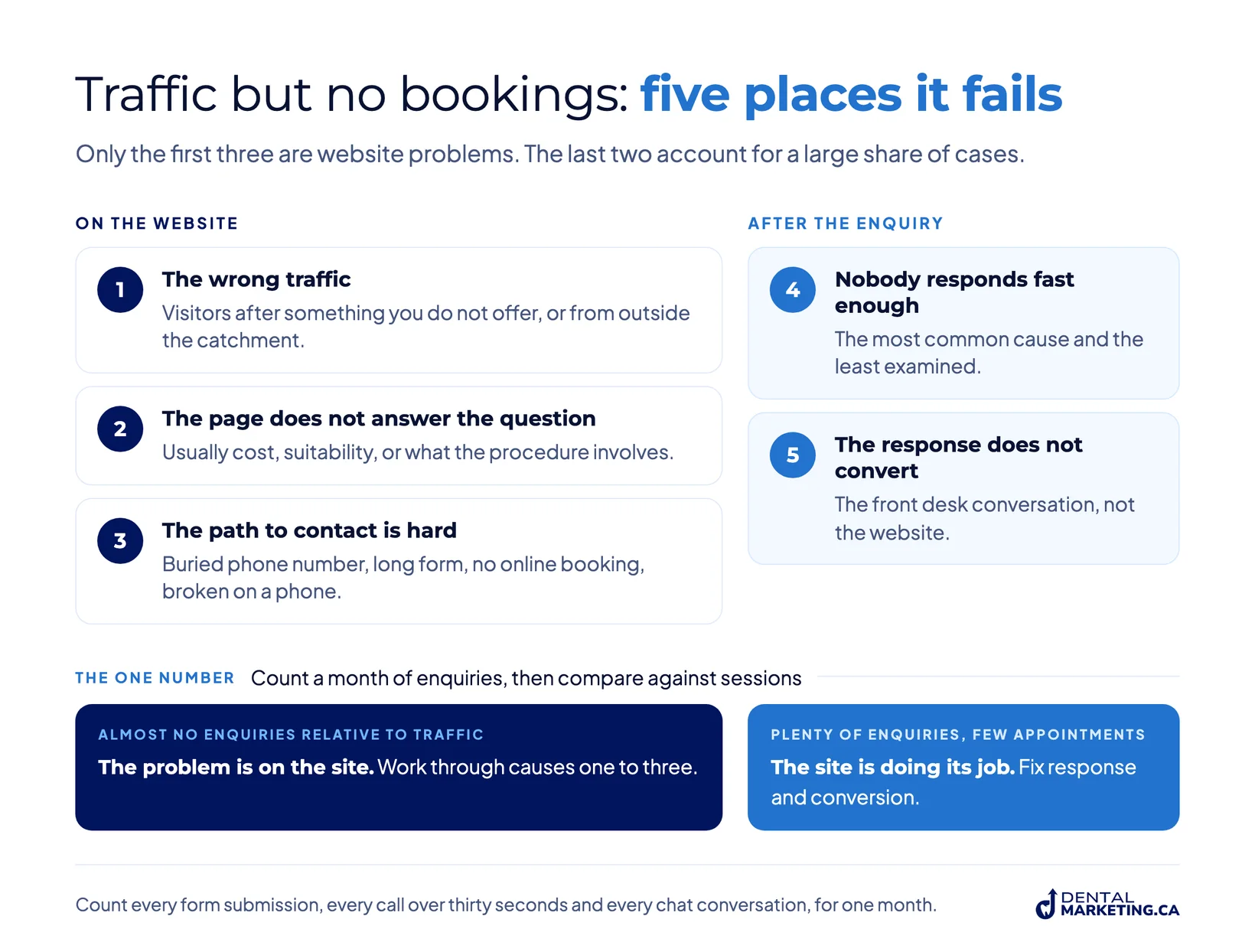
- The traffic is the wrong traffic. Visitors arriving for something the practice does not offer, or from outside the catchment.
- The page does not answer what the visitor came to find out. Usually cost, suitability, or what the procedure actually involves.
- The path to contact is harder than it looks. Buried phone number, long form, no online booking, broken on a phone.
- Someone enquires and nobody responds fast enough. Notably, this is the most common cause and the least examined.
- The response happens but does not convert. That is the front desk conversation, not the website.
Only the first three are website problems. The last two account for a large share of cases, and no redesign will touch them.
Is the problem the site, or what happens after the enquiry?
One number separates them, and most practices have never looked at it: how many enquiries actually arrived.
Count every form submission, every call over thirty seconds, and every chat conversation for one month. Then compare against sessions.
- Almost no enquiries relative to traffic? The problem is on the site. Work through causes one to three.
- Plenty of enquiries but few appointments? The website is doing its job. The problem is response and conversion, causes four and five.
This single check redirects a large number of practices away from a redesign they did not need. It is worth doing before any proposal is signed.
What a dental website audit usually finds
When a practice tells us the site gets traffic but the phone is not ringing, we usually know roughly what the audit will turn up. In practice it is close to the same short list every time.
Across the practices that have come to us for a dental website audit, the large majority had at least one structural conversion problem sitting on the site before anybody touched the marketing. We would put it at around eighty five percent. Notably, these are not design problems. A phone number you cannot tap on a phone. A contact form asking a nervous stranger for more than they will give. No way to book outside office hours. Treatment pages that never answer the question the patient arrived with.
However, two honest caveats belong with that figure. First, it is our own observation across practices that approached us, not a controlled study. Second, practices that approach a marketing agency are self-selected for already suspecting something is wrong. So a random sample of Canadian dental websites would look better than the sample in front of us. Still, we are confident about the direction. These problems are common, cheap to fix, and almost never what the practice planned to spend money on.
The uncomfortable version is that in a good share of these audits the site was fine. So was the traffic. Instead, the enquiries were arriving and nobody reached them quickly enough, or at all after five o’clock. Certainly we have told practices to spend nothing with us on a rebuild and to go fix the front desk process first. Ultimately that advice has produced faster results than most of the paid work we could have sold them instead.
What do patients need before they will call?
A visitor considering treatment is weighing cost, fear and whether they are even a suitable candidate. A site that answers none of those is asking them to phone in order to find out basic facts, and many will simply not do that.
What consistently moves the number:
- Some signal about cost. Even a range, or an explanation of what affects the price. Silence reads as expensive.
- Candidacy. Who the treatment suits and who it does not. This filters out unsuitable enquiries as well as encouraging suitable ones.
- What actually happens. Appointment by appointment. Anxiety is a bigger obstacle than price for a large share of patients.
- Financing, visible before the consultation. For higher-value treatment this changes who is willing to book at all.
- Proof you exist and are real. Hours, parking, accessibility, who will be treating them.
One important Canadian constraint: the reassurance most American sites lean on is not available here. Patient testimonials, superlatives and outcome promises are restricted or prohibited by provincial regulators. The substitute is information rather than persuasion, which is harder to write and tends to convert better with a hesitant patient anyway.
How fast do you have to answer an enquiry?
Faster than almost any practice believes. A patient who submits a form is very often submitting several, and the practice that responds first has an enormous structural advantage over the one that responds thoughtfully an hour later.
Worth measuring three things, none of which usually are:
- Median time to first contact, from enquiry to a human actually reaching the patient.
- How many enquiries received more than one attempt. One call and a voicemail is not follow-up.
- What happens outside office hours. A meaningful share of enquiries arrive in the evening, and a Monday morning callback is competing against whoever answered on Saturday.
This is not a website issue and no designer will fix it. It is a conversion and follow-up system problem, and it is usually cheaper to fix than anything else on this list.
The one change worth making first
If we can change only one thing, it is who picks up, how fast, and what happens in the evening. Not the dental website.
Meanwhile the evidence people quote here is worth understanding properly, because almost everyone quotes it wrong. The well known lead response research came out of MIT, led by James Oldroyd, using three years of data from six companies and more than fifteen thousand leads. Certainly it is useful. Still, it has two limits nobody mentions. It is sales-team data about companies calling web-generated leads, not anything to do with healthcare. Also, it dates from 2007.
Then there is the misreading. The famous line says responding in five minutes makes you a hundred times more likely to qualify a lead. In fact the hundredfold difference is in whether you reach the person at all. The qualification difference is about twenty one times. Both are large. However, neither is a dental statistic, and we will not present it as one.
From our own work, the practices with this complaint are almost never slow because nobody cares. Rather, the enquiry lands in an inbox one person checks between patients. There is no second attempt when the first call misses. And nothing happens between Friday evening and Monday morning. Typically a patient who fills in a form on a Saturday has filled in two or three. So by Monday, whoever called back first has already settled who treats them.
Fixing that costs close to nothing. It is a rule about who responds, a rule that every enquiry gets more than one attempt, and some coverage for evenings and weekends. Obviously we would do that before spending a dollar on traffic. We have lost work by saying so.
What should you fix first?
In order of cost against likely effect. Start at the top and stop when the number moves.
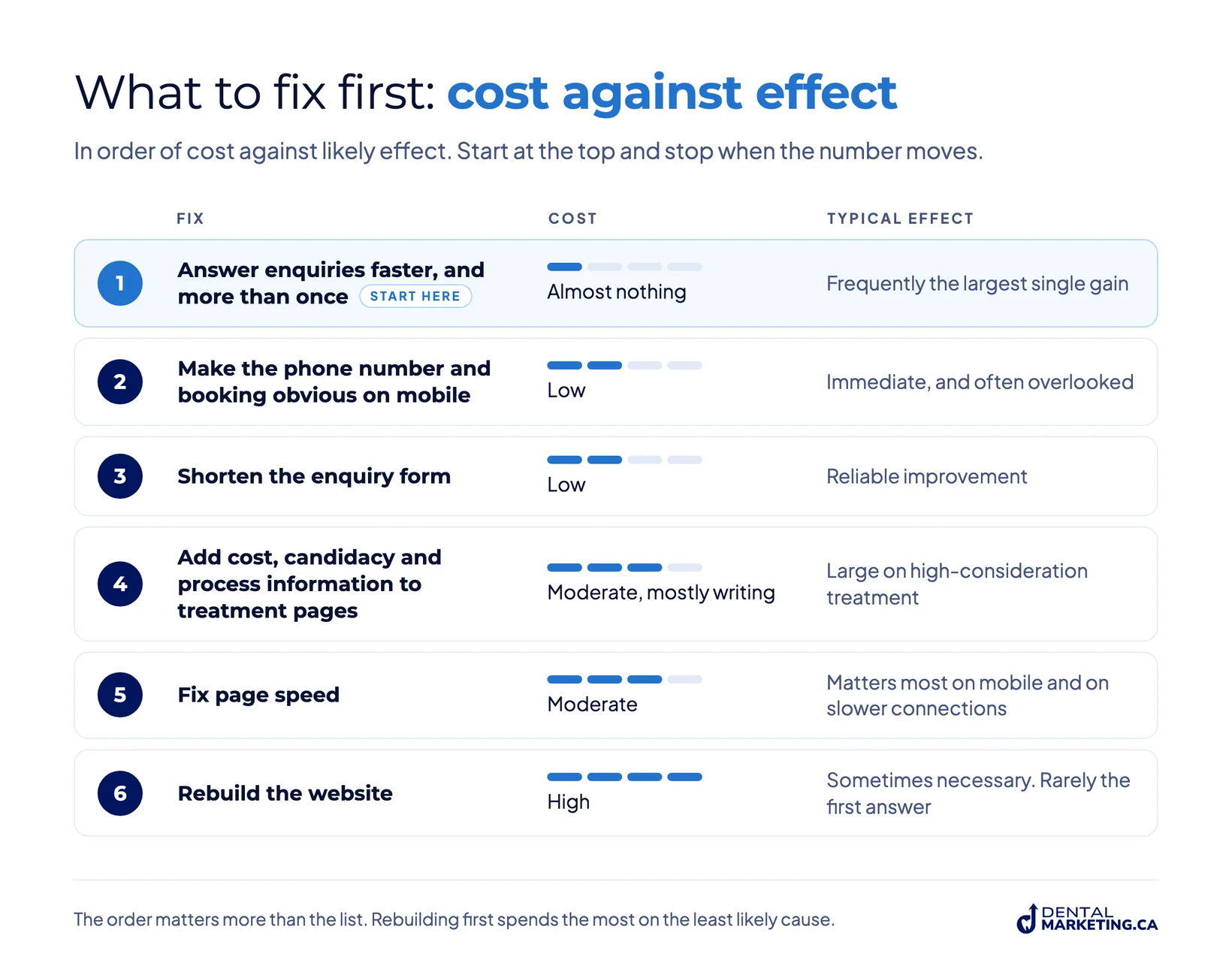
| Fix | Cost | Typical effect |
|---|---|---|
| Answer enquiries faster, and more than once | Almost nothing | Frequently the largest single gain |
| Make the phone number and booking obvious on mobile | Low | Immediate, and often overlooked |
| Shorten the enquiry form | Low | Reliable improvement |
| Add cost, candidacy and process information to treatment pages | Moderate, mostly writing | Large on high-consideration treatment |
| Fix page speed | Moderate | Matters most on mobile and in slower connections |
| Rebuild the website | High | Sometimes necessary. Rarely the first answer |
The order matters more than the list. A practice that rebuilds first has spent the largest amount available on the least likely cause, and will still have the same response-time problem afterwards.
When does a dental website genuinely need rebuilding?
Occasionally it is, and the signals are fairly clear:
- The site is not usable on a phone, where the majority of the traffic is
- There is no page for treatments the practice actually wants
- Load times are bad enough that visitors leave before it renders
- The content cannot be edited without a developer, so nothing will ever improve
- Claims on the site would not survive a look from the provincial regulator
Those are structural. Everything above them on the list should be tested first, because they are cheaper and faster and they frequently resolve the problem on their own.
How to tell whether the traffic arriving is even the right traffic is a search question rather than a design one, covered in how long dental SEO takes to work. Judging whether any of it is paying needs conversion tracking that reaches started cases, and if the traffic comes from search, what dental SEO should cost sets the bar it has to clear.
Diagnosing which of the five causes is actually yours, before proposing anything, is how we start website work with a practice.
This article describes advertising and privacy rules as they applied on the review date shown. Regulations change and vary by province. This is general information, not legal advice. Confirm anything you intend to rely on with your own regulatory college.

 Speak to a dental marketing specialist